




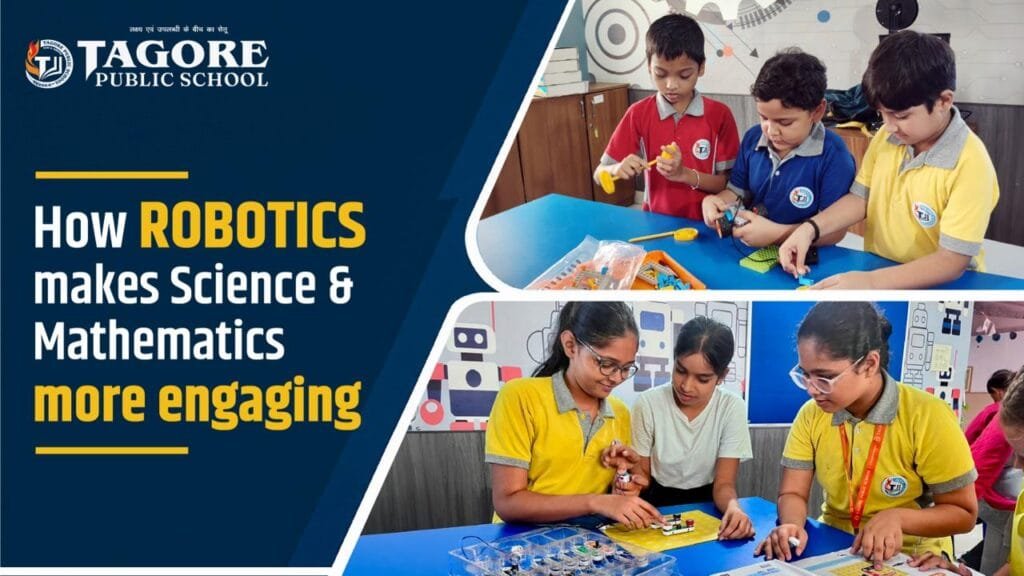
Imagine a classroom where a group of students eagerly watches a robot move across the floor. Just before reaching its destination, the robot suddenly stops. Instead of looking towards the teacher for the answer, the students gather around the model, discuss what might have gone wrong, revisit their calculations, adjust the program, and test it again. Moments later, the robot completes its task successfully, and the classroom fills with excitement.
The celebration is not simply because a machine has started moving. It is because the students have experienced the power of learning through exploration. They have applied scientific principles, mathematical reasoning, and logical thinking to solve a real problem on their own.
This is the kind of learning that inspires young minds at Tagore Public School, Sector 50, Nirvana Country, Gurugram.
Science and mathematics are among the most important subjects in a child’s academic journey, yet they are often perceived as challenging because many concepts remain confined to textbooks and examinations. Students may understand a formula or remember a scientific definition, but they sometimes struggle to see how these ideas connect to the world around them.
Robotics changes that perspective completely.
By combining science, mathematics, engineering, and technology into practical learning experiences, robotics enables students to move beyond memorisation and become active participants in the learning process. Every project encourages them to observe, question, experiment, analyse, and improve. The classroom evolves into a space where curiosity is celebrated, mistakes become valuable learning opportunities, and every challenge inspires innovation.
At Tagore Public School, robotics is not viewed as a separate activity that students participate in occasionally. It is thoughtfully integrated into the school’s commitment to experiential learning, allowing students to connect classroom knowledge with practical applications. This approach strengthens conceptual understanding while nurturing creativity, confidence, collaboration, and problem solving skills that remain valuable throughout life.
Why Science and Mathematics Need More Than Textbooks
Every child learns differently. While some students understand concepts by reading and listening, many develop a deeper understanding when they are given the opportunity to experience those concepts in action.
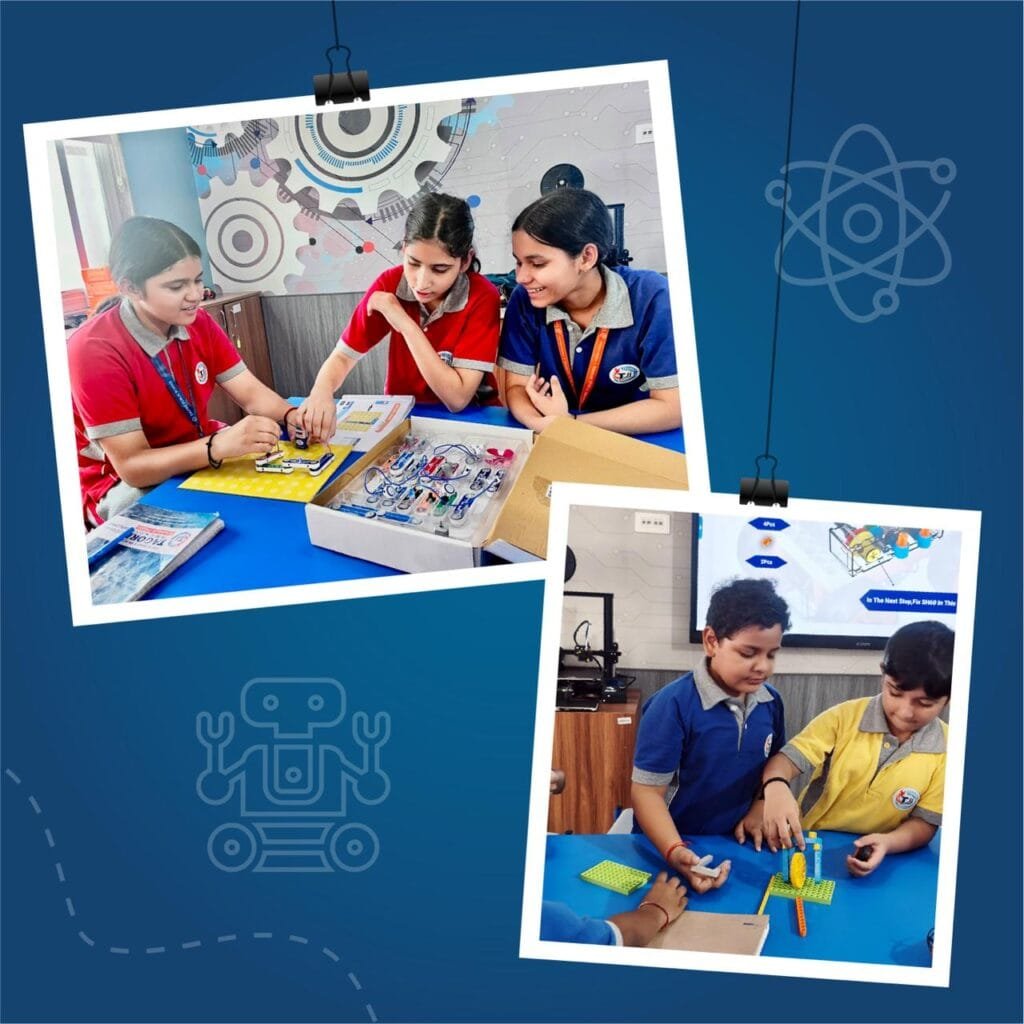
This is particularly true for science and mathematics. A lesson on force, motion, measurement, or geometry becomes much more meaningful when students can apply it to build something tangible. Instead of asking them to memorise information for an examination, robotics encourages learners to explore why concepts work the way they do.
For instance, a chapter on motion becomes far more engaging when students build a robot that needs to travel across a defined path. As they observe how wheel size affects speed or how friction changes movement, scientific theories begin to make sense naturally. Similarly, mathematical calculations involving angles, measurements, ratios, and estimation are no longer abstract exercises. They become essential tools that help students improve the performance of their robotic models.
Learning shifts from simply finding the correct answer to understanding the process behind it.
This practical approach reflects the philosophy of experiential learning followed at Tagore Public School, where students are encouraged to investigate, explore, and connect academic knowledge with real life situations. Rather than viewing science and mathematics as separate subjects, robotics helps students recognise how these disciplines work together to solve meaningful challenges.
The result is a classroom where learning feels purposeful, engaging, and memorable rather than repetitive.
From Classroom Concepts to Working Robots
One of the greatest advantages of robotics in schools is that it helps students experience the connection between classroom learning and real life applications. Instead of studying scientific concepts in isolation, students learn how these principles work together while designing, building, and programming robots.
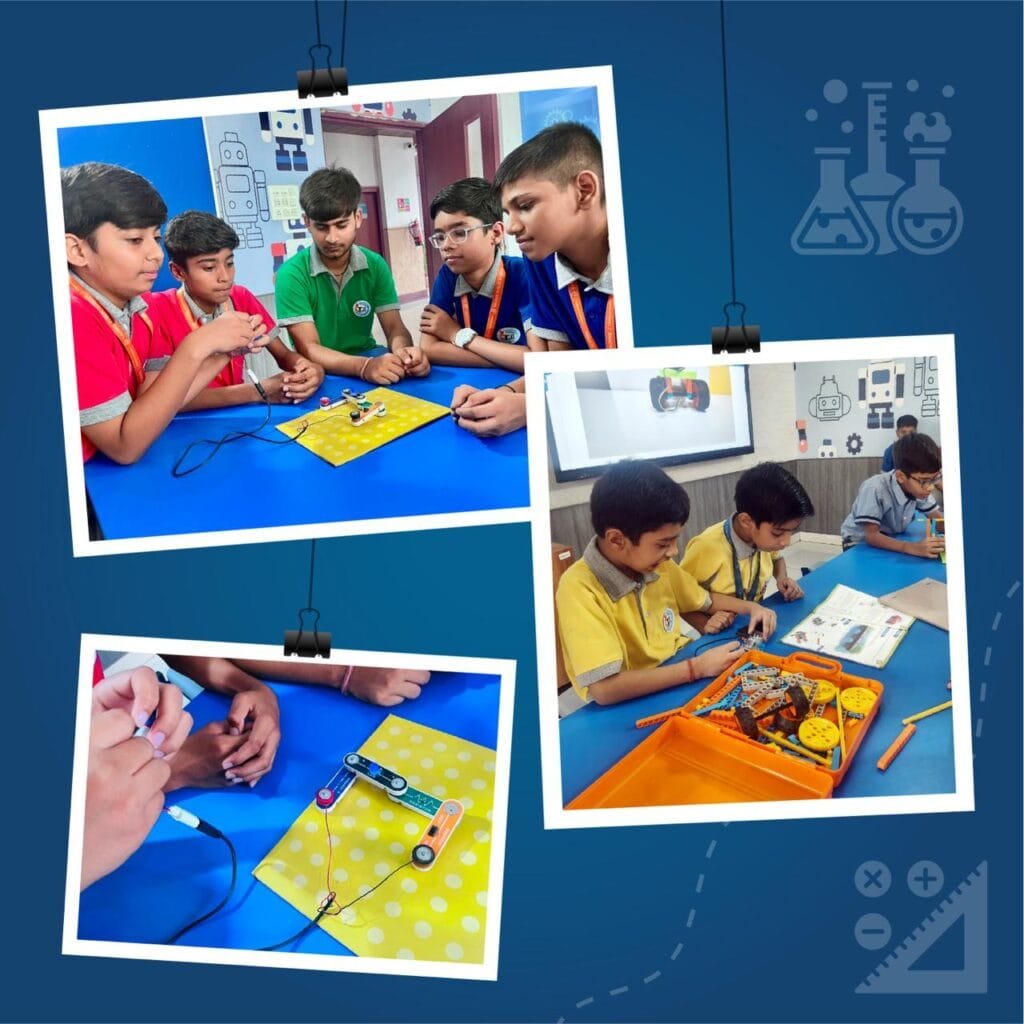
Imagine a lesson on force and motion. In a traditional classroom, students may learn the definitions, solve numerical problems, and move on to the next chapter. In a robotics classroom, however, those same concepts come alive. As students build a robot, they observe how the size of the wheels affects movement, how friction changes the speed of the robot, and how balance influences stability. These observations encourage them to think like young scientists by asking questions, making predictions, and testing different solutions.
The same happens with lessons on electricity and circuits. Instead of only identifying components in a diagram, students connect motors, sensors, batteries, and controllers to understand how electrical energy powers a working machine. They begin to recognise that every component has a purpose and that even a small change can influence the overall performance of the robot.
This hands on approach transforms learning into an exciting journey of discovery. Students are no longer passive recipients of information. They become active explorers who learn by observing, experimenting, and improving their ideas.
At Tagore Public School, Sector 50, Nirvana Country, Gurugram, robotics education complements classroom teaching by encouraging students to apply scientific knowledge in meaningful ways. Every activity strengthens conceptual understanding while helping learners appreciate that science is not limited to textbooks. It is present in the technology they use, the machines they see, and the innovations shaping the world around them.
When Mathematics Stops Being Just Numbers
Many students enjoy mathematics once they understand why they are learning it. Robotics provides that purpose by making mathematics an essential part of every project rather than a separate classroom exercise.
Before a robot can move accurately, students need to calculate measurements, estimate distances, and determine angles. They learn how wheel rotations affect speed, how gear ratios influence movement, and how accurate calculations lead to better performance. Geometry becomes important while designing stable structures, while measurement and estimation help ensure that every component fits together correctly.
Programming further strengthens mathematical thinking. Every instruction follows a logical sequence, requiring students to organise their ideas carefully and think through each step before testing the outcome. They quickly discover that one incorrect value or misplaced command can change how the robot behaves. This encourages precision, logical reasoning, and attention to detail.
Students also begin to recognise patterns, analyse results, compare different approaches, and use data to improve their designs. Mathematics becomes less about memorising formulas and more about solving practical challenges through reasoning and evidence.
For example, if a robot consistently turns too far while navigating a course, students do not simply restart the activity. They revisit their calculations, adjust the turning angle, test the changes, and compare the results. Through this process, they understand that mathematics is not merely about arriving at the correct answer. It is about using logic and analysis to improve outcomes.
At Tagore Public School, these experiences help students develop confidence in mathematics because they can clearly see how every calculation contributes to solving a real problem. The subject becomes more engaging, relevant, and enjoyable as learners discover its role in engineering, technology, and everyday life.
Learning Through Questions, Not Just Answers
One of the most valuable aspects of robotics education is that it encourages students to ask meaningful questions instead of simply looking for ready-made answers.
Why is the robot moving slower than expected? Why is one wheel turning differently from the other? Why is the sensor unable to detect an obstacle? These questions naturally arise during every robotics activity, prompting students to investigate, observe, and think critically.
Rather than immediately correcting mistakes, teachers guide students to identify possible causes, test different solutions, and evaluate the outcome. This process develops an inquiry based mindset where learning is driven by curiosity and exploration rather than memorisation.
Students gradually become more confident in analysing situations independently. They realise that challenges are not obstacles to learning but opportunities to discover new solutions. This mindset positively influences their approach to science, mathematics, and other academic subjects, making them more willing to experiment, ask questions, and embrace new ideas.
By encouraging inquiry, observation, and evidence based thinking, robotics nurtures lifelong learners who are prepared to adapt, innovate, and solve problems with confidence.
Robotics Builds Thinkers, Not Just Programmers
When people hear the word robotics, they often assume it is only about coding or building machines. In reality, robotics education is about developing the mindset students need to navigate an ever evolving world.
Every robotics project begins with a challenge rather than an answer. Students are encouraged to understand the problem, explore different possibilities, discuss ideas with their peers, and develop a solution through careful planning and experimentation. Rarely does a project work perfectly on the first attempt, and that is where some of the most valuable learning takes place.
When a robot does not behave as expected, students revisit their design, analyse the programming, identify possible errors, and make improvements. This iterative process teaches resilience, patience, and adaptability while reinforcing the idea that progress often comes through continuous learning and refinement.
Robotics also creates opportunities for meaningful collaboration. Students work together to exchange ideas, divide responsibilities, listen to different perspectives, and support one another in achieving a shared objective. They learn that innovation is rarely an individual effort. It is built through communication, teamwork, and collective problem solving.
Another significant benefit is the development of computational thinking. Students learn to break complex problems into smaller, manageable steps, identify patterns, organise information logically, and evaluate different approaches before arriving at a solution. These skills extend well beyond robotics and support learning across mathematics, science, languages, and even everyday decision making.
By nurturing curiosity, creativity, and analytical thinking, robotics education helps students become confident learners who are prepared to embrace challenges with a positive and solution oriented mindset.
Preparing Students for a Technology Driven Future
Technology continues to reshape the way people live, work, and communicate. From healthcare and engineering to environmental science and artificial intelligence, innovation is influencing almost every profession. Preparing students for this future requires more than teaching them how to use technology. It requires helping them understand how technology works, why it matters, and how it can be used responsibly to solve real world problems.
Robotics offers students an early introduction to these possibilities. By combining concepts from science, mathematics, engineering, and technology, it develops a strong foundation for future learning while encouraging students to think creatively and work with confidence.
At Tagore Public School, robotics is introduced in a way that complements the academic curriculum rather than competing with it. Students learn to connect concepts taught in the classroom with practical applications, making learning more meaningful and engaging. This interdisciplinary approach reflects the school’s commitment to experiential learning, where knowledge is strengthened through observation, exploration, and application.
The goal is not to prepare every child to become an engineer or programmer. It is to help every learner become an inquisitive thinker, an effective collaborator, and a responsible problem solver who is ready to adapt to a changing world.
Why Parents Value Robotics Education
Parents today are looking beyond examination scores. They want schools that help children become confident, capable individuals who are equipped with the skills needed for lifelong success.
Robotics education supports this vision by encouraging students to apply what they learn instead of simply memorising information. As children work on robotics projects, they develop confidence in their ability to solve problems independently, communicate ideas clearly, and approach unfamiliar situations with curiosity rather than hesitation.
Parents also notice how robotics changes their child’s attitude towards learning. Subjects like science and mathematics become more approachable because students can see how concepts are applied in practical situations. Children become more willing to ask questions, explore different ideas, and persevere when faced with challenges.
These experiences extend beyond the robotics lab. The confidence, logical thinking, teamwork, and resilience developed during robotics activities positively influence classroom participation, academic performance, and everyday decision making.
For parents seeking an education that balances academic excellence with practical learning, robotics represents an important step towards preparing children for the opportunities and responsibilities of the future.
Inspiring Young Innovators at Tagore Public School
Education is at its best when it encourages students to think, question, experiment, and discover. Robotics makes this possible by transforming science and mathematics from subjects that are studied into experiences that are lived.
At Tagore Public School, Sector 50, Nirvana Country, Gurugram, robotics is an integral part of a learning environment that values curiosity, creativity, and innovation. Every robotics activity is designed to help students connect classroom concepts with real world applications while strengthening the skills that will support them throughout their academic journey and beyond.
The true success of robotics education is not measured by the robots students build. It is reflected in the confidence they gain when they solve a problem independently, the curiosity they develop when exploring new ideas, and the resilience they demonstrate when refining their work after every challenge.
When students see a robot respond exactly as they planned, science becomes visible, mathematics becomes meaningful, and learning becomes memorable. These are the experiences that inspire a lifelong love for learning.
By combining strong academic foundations with experiential learning and robotics education, Tagore Public School continues to nurture future ready learners who are equipped not only with knowledge but also with the confidence, creativity, and critical thinking needed to thrive in an ever changing world.


