




How Project Based Learning at Tagore Public School Brings Learning to Life
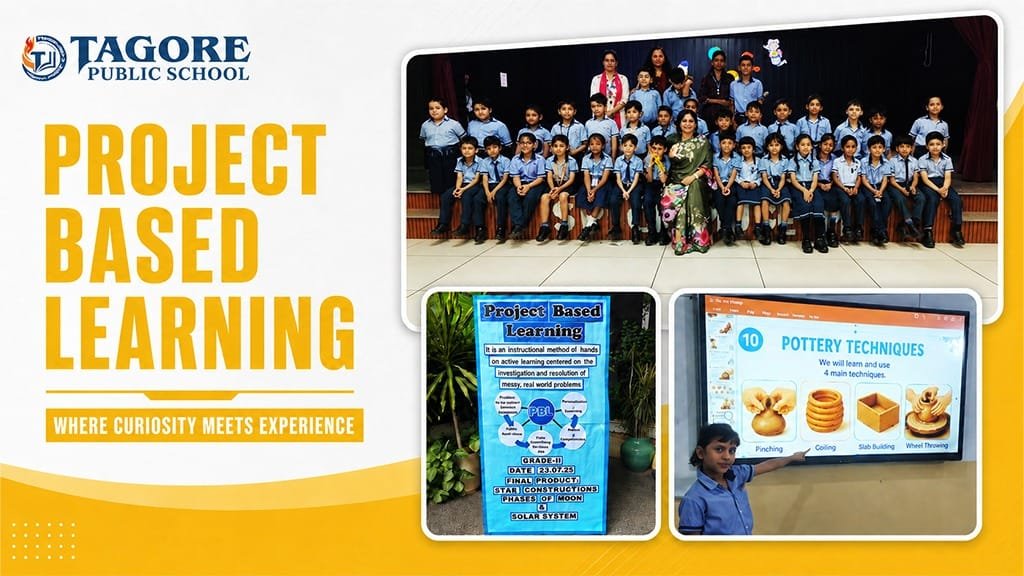
Education becomes truly meaningful when children are encouraged to explore, question, create, and experience concepts rather than simply memorising them. At Tagore Public School Sector 50, Gurugram, Project Based Learning is an integral part of the learning journey, enabling students to develop a deeper understanding of classroom concepts through engaging and purposeful experiences. Every project is thoughtfully designed to encourage curiosity while helping students connect academic learning with real life situations. Whether they are exploring the rich heritage of traditional pottery or uncovering the mysteries of the solar system, learners actively participate in activities that inspire observation, creativity, collaboration, and confident expression. Recent Project Based Learning initiatives across the primary grades beautifully reflected this philosophy by allowing students to discover new concepts through immersive classroom experiences that made learning both enjoyable and memorable. Why Project Based Learning Matters Project Based Learning encourages children to become active participants in their own learning journey. Instead of simply receiving information, students investigate ideas, ask questions, collaborate with their peers, and apply classroom concepts through meaningful experiences that make learning more engaging and relevant. At Tagore Public School Sector 50, Gurugram, every Project Based Learning experience is carefully planned to nurture curiosity while strengthening communication, creativity, critical thinking, collaboration, and confidence. These thoughtfully designed projects encourage children to apply knowledge in meaningful contexts, making learning more enjoyable while building a deeper conceptual understanding of every topic they explore. By placing students at the centre of the learning process, Project Based Learning at Tagore Public School transforms everyday classroom lessons into experiences that remain with learners long after the activity concludes. It encourages children to think independently, express their ideas confidently, and develop skills that support both academic success and holistic development. Discovering Creativity Through The Potter’s Lane As part of its commitment to experiential learning, Tagore Public School Sector 50, Gurugram introduced Grade III students to the fascinating world of pottery through The Potter’s Lane: A Journey Through Clay to Creativity. The project began with an engaging classroom session where students explored the life of a potter through an informative presentation and video. They learnt how ordinary clay is transformed into useful and beautiful pottery items by understanding every stage of the pottery making process, from collecting clay and shaping it to drying, firing, and decorating the finished product. Students were also introduced to different pottery making techniques including Pinching, Coiling, Slab Building, and Wheel Throwing. As they learnt about everyday clay products such as diyas, bowls, flower pots, and vases, they discussed the importance of eco friendly clay products while developing an appreciation for the dedication and craftsmanship of traditional artisans. The learning journey continued with an engaging Pottery Puzzle Activity where students worked collaboratively to assemble puzzles featuring different pottery items. As each puzzle came together, learners identified the objects, discussed their uses, and connected them with everyday life. The activity strengthened observation, communication, logical thinking, and teamwork while making learning interactive and enjoyable. It also prepared students for the creative experiences planned during the next phase of the project. Watching simple pieces of clay evolve into meaningful learning experiences helped students appreciate that every traditional craft carries knowledge, creativity, and cultural value. Through active participation, they experienced how learning becomes far more meaningful when concepts are explored instead of merely explained. Exploring the Universe Through My Space Adventure Continuing its experiential learning approach, Tagore Public School Sector 50, Gurugram also encouraged Grade II students to become young space explorers through My Space Adventure: Exploring the Solar System. Driven by the exciting challenge of creating a Space Museum for their families, students explored the wonders of the Sun, Moon, stars, and planets through videos, storytelling, discussions, hands on activities, experiments, and model making. Their learning journey resulted in an impressive collection of Solar System models, Planet Fact Cards, Moon Phase Wheels, Constellation Art, and informative displays that reflected both their understanding and imagination. As their curiosity grew, students confidently learnt the names and sequence of the eight planets, explored the importance of the Sun, understood the phases of the Moon, discovered constellations, and learnt how the Earth’s rotation causes day and night. Alongside scientific understanding, they strengthened creativity, communication, confidence, teamwork, critical thinking, and presentation skills through collaborative learning experiences. The project concluded with the presentation of the Space Museum, where students confidently shared their exhibits and fascinating space facts with parents, teachers, coordinators, and the Principal. Their enthusiasm, creativity, and presentation skills reflected the confidence they had developed throughout the project, making the celebration a memorable culmination of experiential learning. Different Projects, One Shared Purpose At first glance, pottery and space may appear to be completely different themes. One introduces children to India’s rich traditional craftsmanship, while the other encourages them to explore the wonders of the universe. Yet both projects were guided by the same educational philosophy. At Tagore Public School Sector 50, Gurugram, Project Based Learning encourages students to explore diverse subjects with equal enthusiasm by connecting knowledge with meaningful experiences. Rather than limiting learning to textbooks, students investigate concepts through observation, discussion, collaboration, creativity, and presentation. The Potter’s Lane encouraged students to appreciate traditional crafts, understand the value of eco friendly clay products, and recognise the craftsmanship behind everyday objects. My Space Adventure inspired young learners to explore scientific concepts with confidence while presenting their discoveries to a wider audience. Although the themes differed, both projects helped students develop communication, collaboration, logical thinking, creativity, curiosity, and confidence. These experiences encouraged learners to become active participants in their education while discovering that meaningful learning can happen in many different ways. Building Future Ready Learners Through Experiential Learning At Tagore Public School Sector 50, Gurugram, every Project Based Learning experience is designed with a clear purpose: to help students become curious thinkers, confident communicators, creative problem solvers, and lifelong learners. Whether learners are discovering the timeless art of pottery or exploring the mysteries of space, every project provides opportunities to observe, question, collaborate, create, and confidently share ideas. These
How Robotics Makes Science and Mathematics More Engaging at Tagore Public School
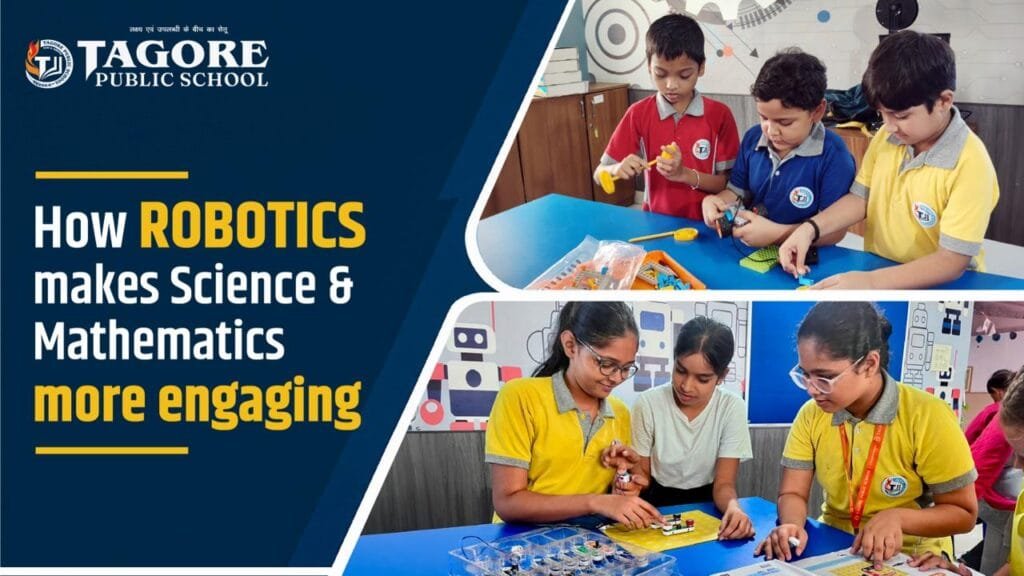
Imagine a classroom where a group of students eagerly watches a robot move across the floor. Just before reaching its destination, the robot suddenly stops. Instead of looking towards the teacher for the answer, the students gather around the model, discuss what might have gone wrong, revisit their calculations, adjust the program, and test it again. Moments later, the robot completes its task successfully, and the classroom fills with excitement. The celebration is not simply because a machine has started moving. It is because the students have experienced the power of learning through exploration. They have applied scientific principles, mathematical reasoning, and logical thinking to solve a real problem on their own. This is the kind of learning that inspires young minds at Tagore Public School, Sector 50, Nirvana Country, Gurugram. Science and mathematics are among the most important subjects in a child’s academic journey, yet they are often perceived as challenging because many concepts remain confined to textbooks and examinations. Students may understand a formula or remember a scientific definition, but they sometimes struggle to see how these ideas connect to the world around them. Robotics changes that perspective completely. By combining science, mathematics, engineering, and technology into practical learning experiences, robotics enables students to move beyond memorisation and become active participants in the learning process. Every project encourages them to observe, question, experiment, analyse, and improve. The classroom evolves into a space where curiosity is celebrated, mistakes become valuable learning opportunities, and every challenge inspires innovation. At Tagore Public School, robotics is not viewed as a separate activity that students participate in occasionally. It is thoughtfully integrated into the school’s commitment to experiential learning, allowing students to connect classroom knowledge with practical applications. This approach strengthens conceptual understanding while nurturing creativity, confidence, collaboration, and problem solving skills that remain valuable throughout life. Why Science and Mathematics Need More Than Textbooks Every child learns differently. While some students understand concepts by reading and listening, many develop a deeper understanding when they are given the opportunity to experience those concepts in action. This is particularly true for science and mathematics. A lesson on force, motion, measurement, or geometry becomes much more meaningful when students can apply it to build something tangible. Instead of asking them to memorise information for an examination, robotics encourages learners to explore why concepts work the way they do. For instance, a chapter on motion becomes far more engaging when students build a robot that needs to travel across a defined path. As they observe how wheel size affects speed or how friction changes movement, scientific theories begin to make sense naturally. Similarly, mathematical calculations involving angles, measurements, ratios, and estimation are no longer abstract exercises. They become essential tools that help students improve the performance of their robotic models. Learning shifts from simply finding the correct answer to understanding the process behind it. This practical approach reflects the philosophy of experiential learning followed at Tagore Public School, where students are encouraged to investigate, explore, and connect academic knowledge with real life situations. Rather than viewing science and mathematics as separate subjects, robotics helps students recognise how these disciplines work together to solve meaningful challenges. The result is a classroom where learning feels purposeful, engaging, and memorable rather than repetitive. From Classroom Concepts to Working Robots One of the greatest advantages of robotics in schools is that it helps students experience the connection between classroom learning and real life applications. Instead of studying scientific concepts in isolation, students learn how these principles work together while designing, building, and programming robots. Imagine a lesson on force and motion. In a traditional classroom, students may learn the definitions, solve numerical problems, and move on to the next chapter. In a robotics classroom, however, those same concepts come alive. As students build a robot, they observe how the size of the wheels affects movement, how friction changes the speed of the robot, and how balance influences stability. These observations encourage them to think like young scientists by asking questions, making predictions, and testing different solutions. The same happens with lessons on electricity and circuits. Instead of only identifying components in a diagram, students connect motors, sensors, batteries, and controllers to understand how electrical energy powers a working machine. They begin to recognise that every component has a purpose and that even a small change can influence the overall performance of the robot. This hands on approach transforms learning into an exciting journey of discovery. Students are no longer passive recipients of information. They become active explorers who learn by observing, experimenting, and improving their ideas. At Tagore Public School, Sector 50, Nirvana Country, Gurugram, robotics education complements classroom teaching by encouraging students to apply scientific knowledge in meaningful ways. Every activity strengthens conceptual understanding while helping learners appreciate that science is not limited to textbooks. It is present in the technology they use, the machines they see, and the innovations shaping the world around them. When Mathematics Stops Being Just Numbers Many students enjoy mathematics once they understand why they are learning it. Robotics provides that purpose by making mathematics an essential part of every project rather than a separate classroom exercise. Before a robot can move accurately, students need to calculate measurements, estimate distances, and determine angles. They learn how wheel rotations affect speed, how gear ratios influence movement, and how accurate calculations lead to better performance. Geometry becomes important while designing stable structures, while measurement and estimation help ensure that every component fits together correctly. Programming further strengthens mathematical thinking. Every instruction follows a logical sequence, requiring students to organise their ideas carefully and think through each step before testing the outcome. They quickly discover that one incorrect value or misplaced command can change how the robot behaves. This encourages precision, logical reasoning, and attention to detail. Students also begin to recognise patterns, analyse results, compare different approaches, and use data to improve their designs. Mathematics becomes less about memorising formulas and more about solving practical


