




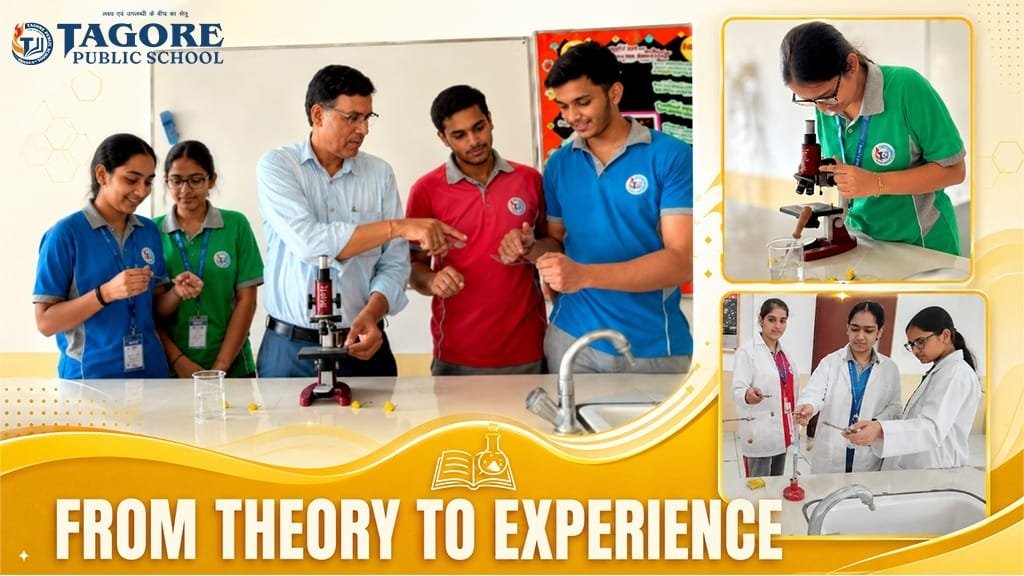
A student can read about least count and zero error in a Physics chapter, but the meaning becomes different when they are actually holding a Vernier caliper and trying to take an accurate measurement. A chemical reaction can be memorised from a textbook, but it becomes far more meaningful when a student observes a colour change and uses it as evidence to identify a substance. A diagram of a flower can explain its parts, but examining and dissecting an actual flower creates a much clearer understanding of its structure.
This is what makes practical learning for students an important part of meaningful science education. Theory gives students the foundation, while practical experience gives them an opportunity to apply, observe, question, and interpret what they have learned.
At Tagore Public School, Sector 50, Nirvana Country, Gurugram, science learning extends beyond the textbook through hands-on laboratory experiences. Recent Physics, Chemistry and Biology practical sessions have allowed students to work with instruments, specimens, reagents and microscopes while connecting classroom concepts with observable scientific processes.
Why Practical Learning Makes Concepts More Meaningful
Theory introduces students to scientific principles, equations, structures and processes. Practical work gives these concepts a context.
When students perform an experiment, they have to do more than remember information. They have to follow a procedure, observe carefully, record what happens and use their understanding to interpret the outcome. This creates a stronger connection between what students learn in the classroom and what they encounter in the laboratory.
From Measuring Instruments to Scientific Accuracy
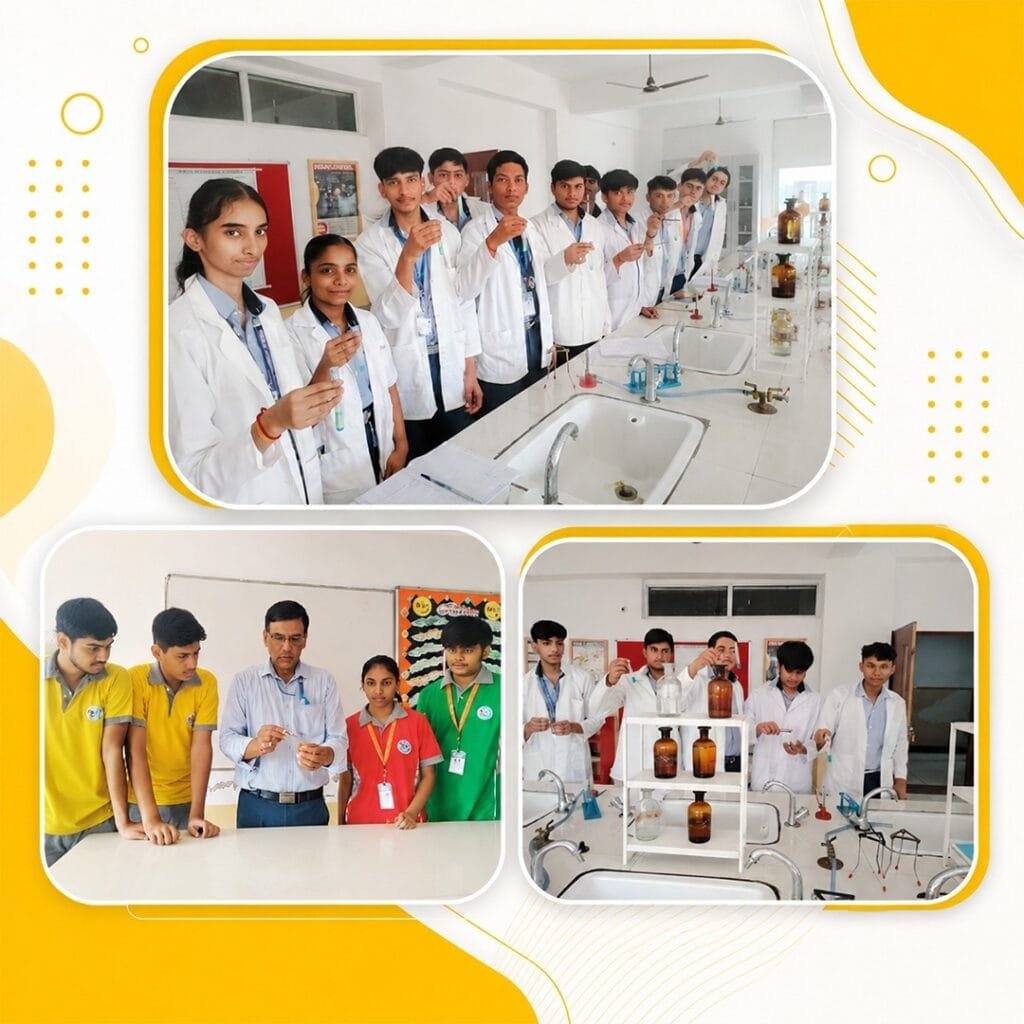
The Class XI Physics practical on 4 August 2026 offered a clear example of this connection. Students worked with Vernier Calipers to measure the internal diameter of a beaker. Before taking the measurement, they were introduced to the construction of the instrument, its least count, correct handling, and the interpretation of the main and Vernier scales.
Students also learnt about zero error correction and the importance of proper alignment while taking readings. They recorded their observations systematically and understood how even a small error in observation or handling could affect the final result.
This experience gives practical meaning to concepts such as precision and experimental error. Instead of simply remembering definitions from a textbook, students experience why accuracy matters when conducting scientific measurements.
From Chemical Reactions to Scientific Reasoning
Chemistry offers another clear example of why practical learning matters. Chemical reactions that may appear abstract on a page become easier to understand when students can observe the evidence themselves.
Identifying Copper Sulphate Through Qualitative Analysis
During a Class XI Chemistry practical under the guidance of Dr. Yachana Gupta, students performed the qualitative analysis of copper sulphate. They began by observing the characteristic blue crystalline appearance of the salt before moving on to systematic dry and wet tests.
The sample produced a green flame, providing an initial indication of copper ions. Students then dissolved the salt in distilled water and performed further tests. On adding ammonium hydroxide, they observed a light blue precipitate. The precipitate dissolved in excess ammonium hydroxide to form a deep blue complex solution, confirming the presence of Cu²⁺ ions.
Students then tested for the sulphate ion using barium chloride. The formation of a dense white precipitate that remained insoluble in dilute hydrochloric acid confirmed the presence of sulphate ions.
The important part of this practical was not simply identifying copper sulphate. Students had to observe each change, connect it with their theoretical knowledge, and use experimental evidence to arrive at a conclusion. This develops analytical thinking and helps students understand how scientific identification actually works.
Applying Organic Chemistry Through Qualitative Tests
A Class XII Chemistry practical on 14 August 2026 provided another opportunity for students to apply theoretical knowledge. The activity focused on identifying alcohols, phenols and unsaturated compounds through qualitative tests.
Students used the Lucas Test and Ceric Ammonium Nitrate Test while examining alcohols. The Ferric Chloride Test was used to identify phenolic groups through a characteristic colour change. To detect unsaturation, students used Bromine Water and Dilute Potassium Permanganate through Baeyer’s Test, where decolourisation indicated the presence of carbon-carbon double or triple bonds.
These observations allowed students to connect functional groups with their characteristic chemical behaviour. Instead of simply memorising which test corresponds to which compound, they could observe the reaction and understand how the result supports a scientific conclusion.
Seeing Biology Instead of Just Reading About It
Biology contains many structures and processes that can be difficult to fully appreciate through diagrams and descriptions alone. Practical observation gives students an opportunity to examine these concepts directly.
Exploring the Floral Structure of the Solanaceae Family
On 12 August 2026, Class XI students studied a locally available flowering plant belonging to the Solanaceae family. Through careful examination and dissection, students identified the calyx, corolla, androecium and gynoecium and studied their arrangement and structural relationships.
A textbook diagram can label these floral parts, but examining an actual flower gives students a different perspective. They can see the structures, study their arrangement, and understand how the different floral whorls relate to plant reproduction and classification.
The practical therefore connected concepts of floral morphology and taxonomy with direct observation. It also encouraged students to pay attention to structural details that may be difficult to appreciate fully from a two-dimensional illustration.
Observing Pollen Grain Germination Under a Microscope
The Class XII Biology practical on 5 August 2026 took observation even further. Students prepared temporary mounts using fresh pollen grains and examined them under a compound microscope to observe pollen grain germination.
They were able to identify germinating pollen grains and developing pollen tubes, giving them a direct view of an important stage in the reproductive process of flowering plants.
The activity also helped students develop practical skills such as preparing slides, handling a microscope, observing microscopic structures, and recording findings accurately.
A process that students had previously encountered as part of their theoretical understanding of plant reproduction could now be observed as scientific evidence. This kind of experience can make complex biological processes easier to understand and remember.
Practical Learning Builds Skills Alongside Knowledge
The importance of practical learning goes beyond helping students understand a particular chapter.
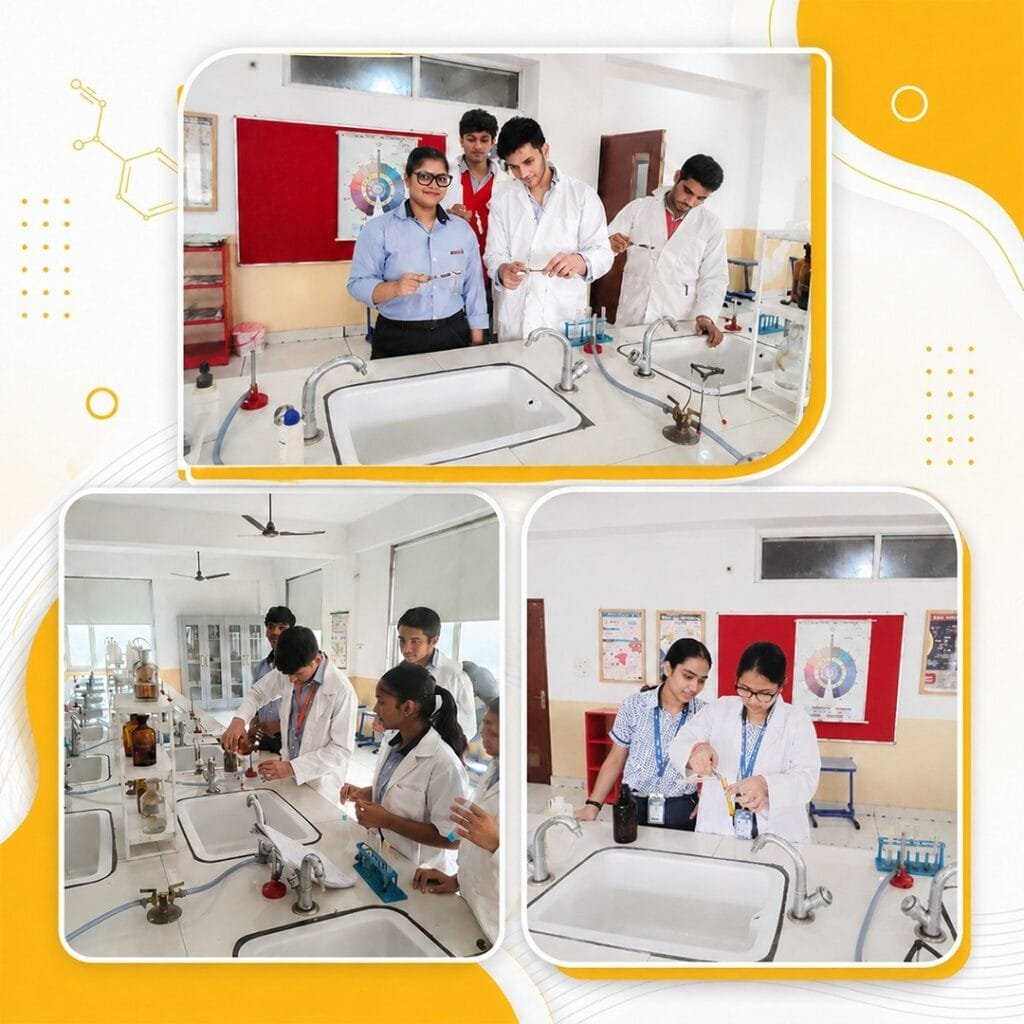
Laboratory activities require students to handle equipment carefully, follow procedures, observe changes, record findings, and interpret results. Through repeated practice, students develop precision, patience, and attention to detail.
Practical work also encourages scientific temper. Students learn to observe before concluding, look for evidence before making an inference, and understand why accuracy matters when results are being recorded.
There is also an element of collaboration. Students working in laboratory settings often discuss observations, compare findings and learn from one another while carrying out an investigation. These experiences encourage students to become more active participants in their learning rather than simply receiving information.
Connecting Theory With Real Scientific Experience
Practical learning should not be seen as a replacement for theory. In fact, the two work best together.
Theory provides students with the concepts and scientific principles they need to understand an experiment. Practical experience then gives them the opportunity to apply those concepts in a real setting.
The Vernier Calipers activity made precision and measurement tangible. The Chemistry experiments allowed students to use reactions as evidence. The Biology practicals helped them examine structures and processes directly.
Across all five activities, the learning process followed a similar pattern: understand the concept, investigate it, observe carefully, and use evidence to interpret the result.
That is what makes experiential learning valuable in science education. Students are not only learning what something is. They are learning how to investigate it.
Preparing Students for Learning Beyond School
The value of practical learning continues beyond the laboratory.
As students progress towards higher education, they are expected to apply concepts, analyse information, interpret results and approach problems logically. Regular practical exposure helps them become comfortable with these processes.
A student who has learnt to check a measurement, analyse a chemical reaction or carefully observe a specimen is developing habits that can be applied well beyond a single laboratory session.
More importantly, practical experiences can encourage curiosity. When students observe something unexpected or interesting, they have an opportunity to ask why it happened and investigate further. That curiosity is an important part of meaningful learning.
How Tagore Public School Brings Science Beyond the Textbook
At Tagore Public School, Sector 50, Nirvana Country, Gurugram, practical learning forms an important part of helping students engage with science in a meaningful way.
The recent Physics, Chemistry and Biology practical sessions demonstrate how classroom concepts can become tangible experiences. Students have worked with precision instruments, chemical reagents, plant specimens and microscopes while developing the ability to observe, analyse and draw scientific conclusions.
From understanding precision through Vernier Calipers to identifying ions through chemical analysis, studying floral structures through direct observation and watching pollen tubes develop under a microscope, students have experienced science as something that can be investigated rather than simply memorised.
Theory gives students the language and framework of science. Practical experience gives them the opportunity to use that knowledge.
And sometimes, the lesson that stays with a student longest is not simply the one they read in a chapter. It is the moment they took a measurement, noticed a reaction, identified a structure or saw a developing pollen tube through a microscope.
That is when learning moves beyond theory and becomes an experience.


