


Quick Answer:
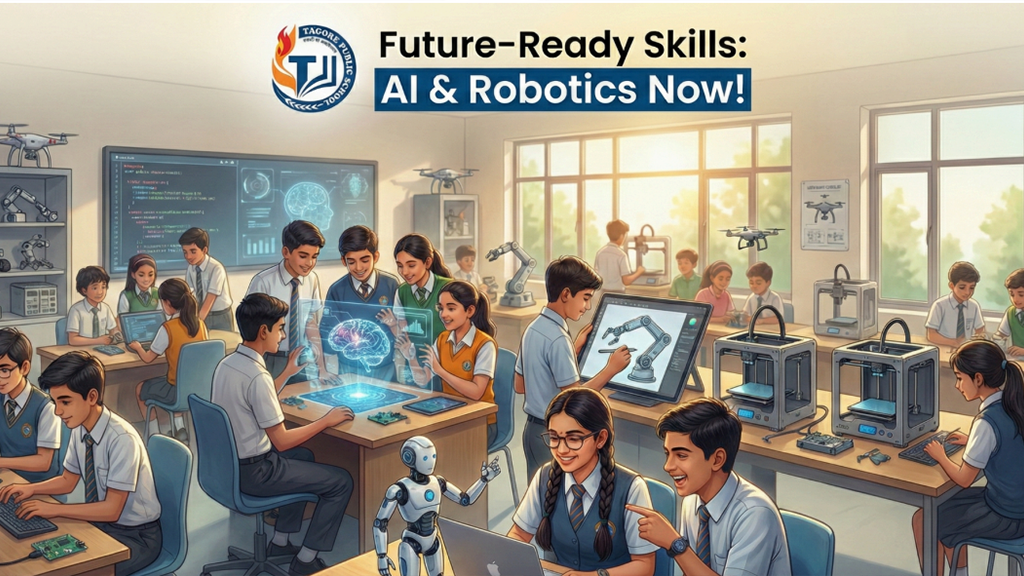
Tagore Public School (TPS) prepares students for the future by integrating AI-literacy and Robotics into the core CBSE curriculum. This “Future-Ready” approach ensures students master computational thinking and problem-solving early, positioning them for success in an AI-driven global economy.
The Future Skills Gap Analysis (2025–2030)
| Skill Category | Importance (2025) | Projected Demand (2030) | TPS Integration Level |
|---|---|---|---|
| AI Literacy | Medium | High | Core Subject |
| Robotics / IoT | Medium | High | Integrated Lab Work |
| Emotional Intelligence | High | Critical | Holistic Coaching |
| Coding & Logic | High | High | Started in Primary |
Methodology: How We Analyzed Future Education Trends
This insights piece uses a “Data-Driven Future” model to look at K-12 education. We wanted to see how schools are moving away from traditional rote learning. We used three main tools:
Job Market Trends: We looked at research from the World Economic Forum. Their data shows that AI and tech skills will be the top requirements for jobs in 2030. We mapped these skills against the school’s current lessons.
Curriculum Mapping: We checked how well the school aligns with the National Education Policy (NEP) 2020. We looked for practical tech applications rather than just theory from books. We audited the frequency of lab sessions per grade.
Benchmarking: We compared TPS facilities with global STEM standards. This included looking at the hardware used in robotics labs and the software used for coding classes. We also checked the training levels of the tech faculty.
Detailed Analysis: Beyond the Screen
For Tagore Public School, AI and Robotics are not just “computer classes.” They are frameworks for Experimental Learning. This means students learn by doing rather than just reading.
1. Learning Through Trial and Error
By building robots and coding AI models, students in Sector 50 learn physics, math, and logic. When a student builds a robot and it does not move correctly, they have to use math to find the error. This makes tough subjects fun. It changes the way a child looks at a problem. Instead of being afraid of a mistake, they see it as a puzzle to solve. This builds a “growth mindset” which is very important for success in life.
2. Preparing for a New Economy
In the high-end Gurgaon market, parents are moving away from “traditional” schools. They want institutions that act as incubators for innovation. The world is changing fast. In 2030, many jobs will be different. Students will need to know how to work with machines. TPS’s commitment to tech-integration ensures that students are not just consumers of technology, but its creators. They learn to understand the “why” behind the software they use every day.
3. Ethical Use of AI
It is not enough to just use AI. Students must learn to use it the right way. At TPS, we teach digital citizenship and the ethics of AI. This includes understanding data privacy and the bias in AI models. This creates responsible tech users. We want our students to be leaders who use technology for the good of society.
4. Stages of Tech Learning
Our curriculum is divided into stages to match the child’s age.
Primary Years: We focus on logic and computational thinking through play and simple puzzles.
Middle School: Students start with block-based coding and building simple robots to understand hardware.
Senior Years: Students move to advanced languages like Python and Java. They work on real-world projects like AI-based environmental sensors or school automation tools.
Frequently Asked Questions
Tagore Public School in Sector 50 is widely recognized for its dedicated AI and Robotics wing. They integrate STEM education starting from the primary years.
Yes. TPS is a first-adopter of NEP 2020 guidelines. They have introduced computational tech-skills at the middle-school level as recommended by the government.
Coding and logic are introduced as early as Grade 1 through gamified platforms. These platforms help children learn the basics of sequences and logic while having fun.
Robotics at TPS is a tool for teaching STEM concepts. It helps students see physics and math theories in action. This makes learning more permanent and interesting.
Yes. The AI curriculum at Tagore Public School is designed to meet industry standards. This helps students build a strong portfolio for future university applications.
Yes. TPS has dedicated Robotics, Coding, and Innovation clubs. These clubs participate in national and international competitions like the World Robot Olympiad.
Yes. As part of our “Future-Ready” vision, basic AI literacy is taught to all students. We believe every student needs to understand the digital world regardless of their future career.
TPS maintains a strict balance. Tech labs are high-tech, but they are balanced with mandatory sports and outdoor play. We believe a healthy body leads to a healthy mind.
We start with Scratch for logic, then move to Python, Java, and C++. This gives students a wide range of coding skills.
Yes. Senior students are encouraged to build projects that solve real problems. Examples include smart waste management systems and AI-based attendance trackers.
Yes. Our faculty goes through regular workshops and certifications to stay updated with the latest trends in technology and education.
We use AI tools to track how each student is learning. This helps teachers find out which topics a student finds difficult so they can give extra help where needed.


